About the Project
Overview
This project collects stories and personal histories of farming within the Middle Rio Grande region of New Mexico. It is elaborated in collaboration between the UNM Food Systems Collaborative, American Friends Service Committee-New Mexico, local farmers, and the convergent curriculum group of the Transformation Network. Casey Holland elaborated the idea for the project during the Food Systems Summit held in February 2025 and remains a close collaborator.
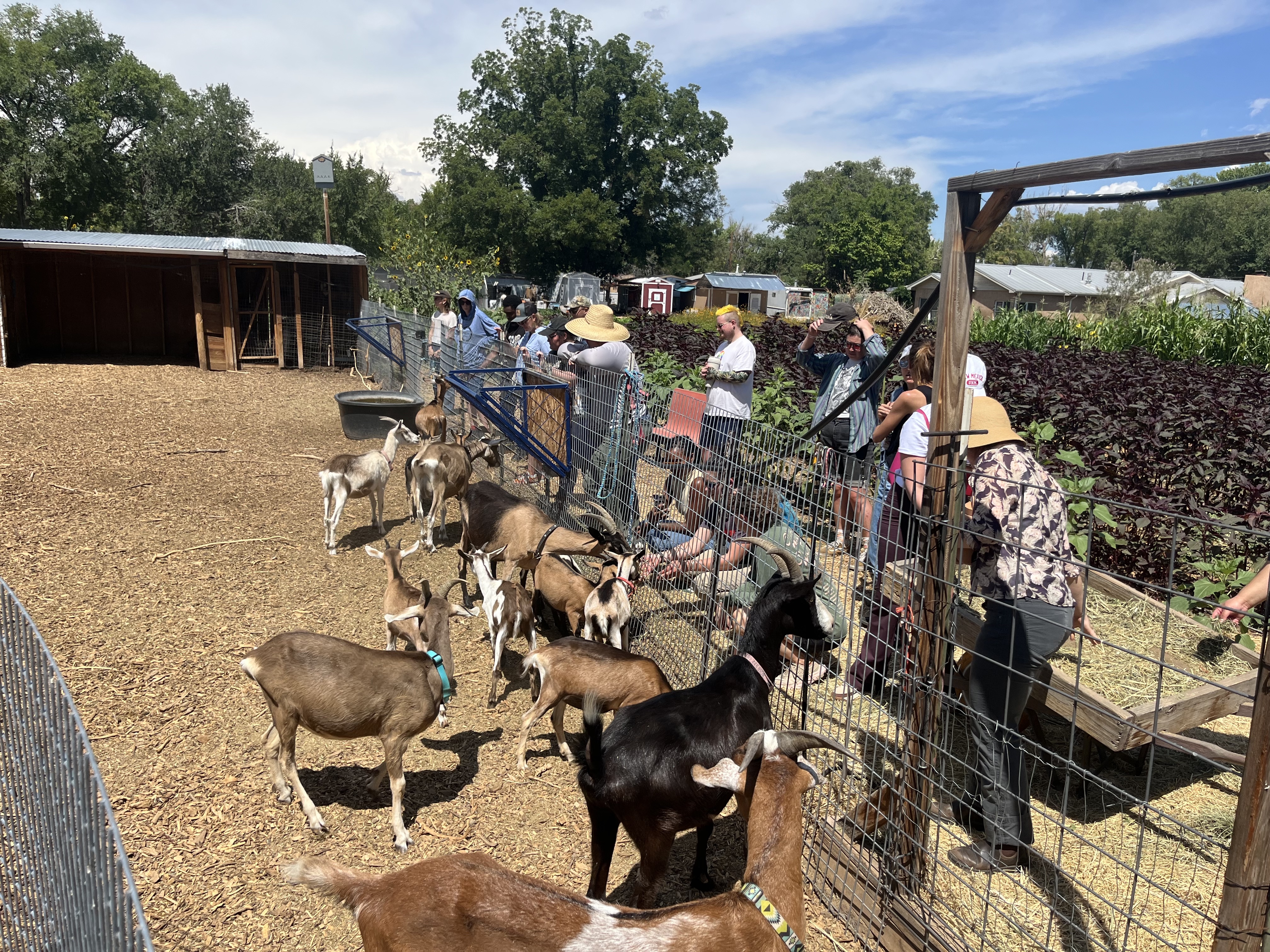
UNM students visit Chispas Farm, Fall 2025
Goals
To capture and archive publicly diverse place-based knowledges that can support resilience in our local food system, document the stories and histories of experienced farmers, and share this knowledge with others in our community.
To provide opportunities for students to learn about and be connected with their local community and food system, and to learn and practice community-engaged research methods.
Timeline
February 2025 – UNM Food Systems Summit. Casey Holland and other practitioners identify storytelling as a key way that farmers learn from each other and build resilience to the challenges of farming. Casey suggests that UNM researchers and students could take an active role in collecting, archiving, and making available these stories.
February – August 2025 – Relationship building and project development. Associate Professor Marygold Walsh-Dilley, who teaches research methods in the Department of Geography & Environmental Studies, begins to develop a community-engaged project that could be undertaken by students in her classes. We build our network, bringing in Sayrah Namaste from AFSC-NM and Jessica Rowland and Tomek Falkowski, faculty at UNM.
August – December 2025 – Study design and initial oral history collection. Students in the class GEOG 589 Qualitative Methods work with community partners to develop the project, ultimately collecting and transcribing 11 oral histories of farmers in the region. January – May 2026 – Project team establishes the Oral Histories of Farming archive in the Center for Southwest Research at the University of New Mexico Libraries. Students in SUST 425 and UHON 301 use the oral histories to generate Farmer Profiles highlighting local food heroes.
Fall 2026 – second round of oral histories collection in GEOG 589: Qualitative Methods
Spring 2026 – second round of archiving and profile generation in SUST 425
We hope to continue with the collection of oral histories and processing of materials for public use for years to come!
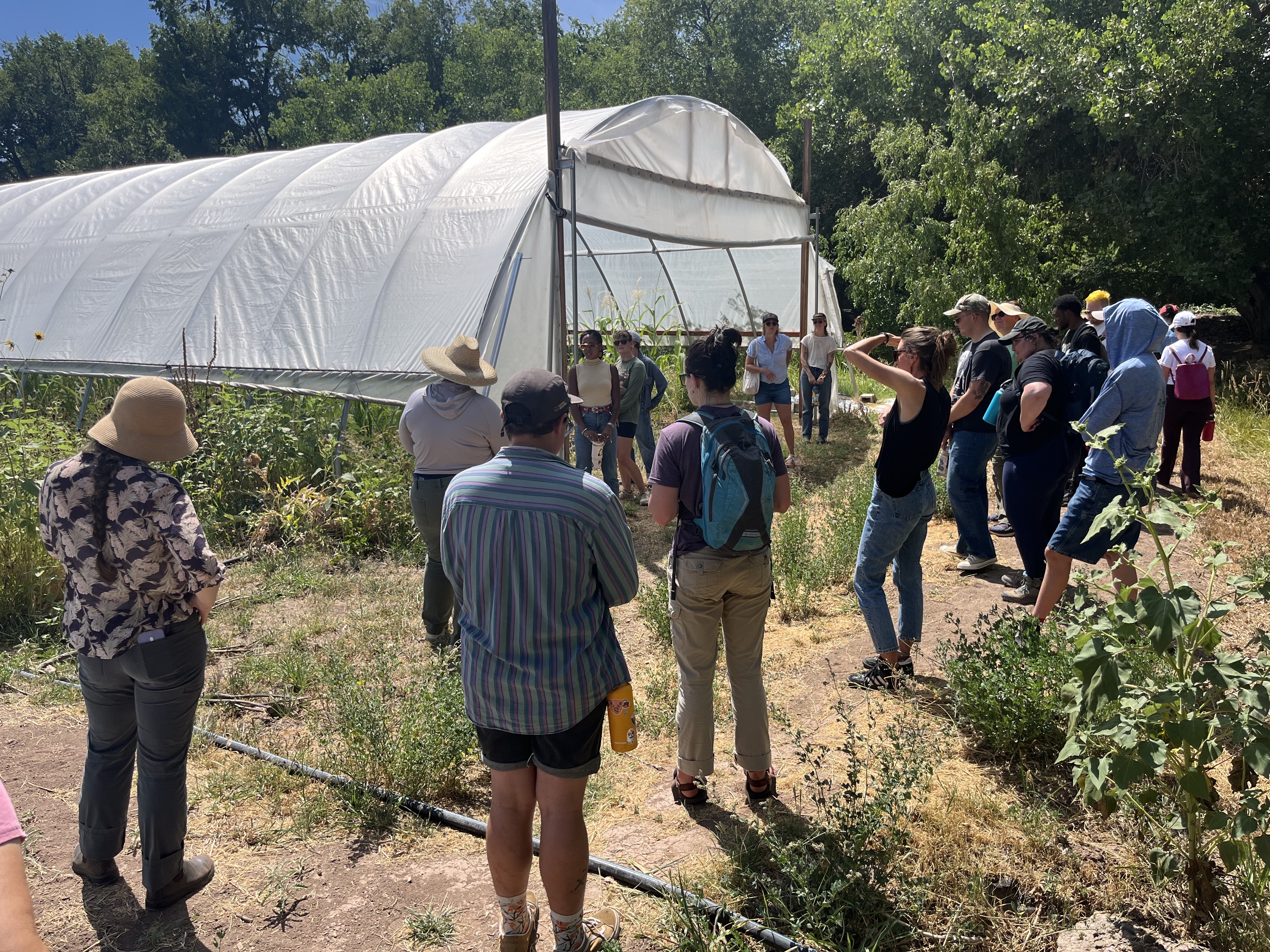
UNM students visit Chispas Farm, Fall 2025
Method and Citation
We use oral history as method. Oral history prioritizes the stories and voice of the person being interviewed, which we call the narrator. Interviewers are prepared with a loose set of initial questions, but the interview is directed by the priorities, interests, and stories of the narrator. We want to hear and prioritize the voices of our local food heroes.
After the interview, interviewers transcribe and loosely edit the transcript for readability. The transcript is returned to the narrator, who can request further edits if they desire. Approved transcripts are included in the archive, along with the original audio. These archives are public. Please recognize the narrator and interviewer as the co-authors of the oral history transcript.
Suggested citation:
Holland, Casey and Olivia Kelly. 2026. “Casey Holland”. Oral Histories of Farming Along the Middle Rio Grande. UNM Digital Repository. https://digitalrepository.unm.edu/oralhistoriesoffarming/6/.