Jack West
The Story of Peas and Hominy Farm
Narrated by: Jack West
Interviewed by: Stephanie Mladinich, Fall 2025 GEOG-589 Qualitative Methods Class
Web Profile by: Makenzi Nyquist & Teagan Stuyvesant, Spring 2026 SUST-364 Local Food Systems Practicum Class
Jack West’s Story
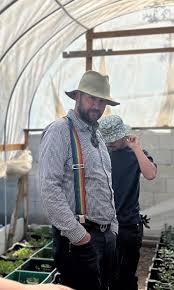
Jack West
To tell you this correctly you need to know that Jack West’s farming story didn’t start in the rural countryside, but in a mechanic’s shop. He went to school to become a mechanic but once he started working as one, he felt extremely unhappy. So one day, he decided to book a trip to France to travel and learn the language. It was there that Jack met a woman named Carissa who introduced him to food and farming, and together they began traveling around France. They both decided to work on farms associated with WWOOF1. At first, he was placed on a farm with livestock and while Jack enjoyed it, the work itself was incredibly draining. He soon left the livestock farm and began working on a vegetable farm with Carissa. They ended up staying there for three months and that experience kickstarted Jack’s passion for farming.
After returning to the States, Jack began bouncing around different farms, honing his skills and growing more passionate about food and farming. He farmed at Los Poblanos in Albuquerque, then worked on farms in North Carolina, Oregon, Pennsylvania, and California. Upon returning to New Mexico, Jack used all the experience he had gained about irrigation, growing practices, and sales to become “The Sweet Potato Guy.”
Finding Oneself
It may sound a little cliché but, on Jack’s travels, he didn’t just learn about farming or growing practices, he learned about himself. As it turns out, finding yourself or finding what you’re willing to fight for is one of the hardest things you can do in life.
When Jack was about to leave the vegetable farm in France, he was talking to the owner and said, “‘I think I’m gonna be an activist and be against Bush or whatever’. The farmer was like ‘You know what? Maybe you should think about being for something instead of against something.’” It was this sentiment that really pushed him into farming and spending his time learning about growing practices. He took a piece of wisdom with him from every farm he ventured to after France. This would ultimately culminate in the establishment of his own farm.
Growth Mindset
One of the biggest things that defines Jack West is his commitment to learning with a growth mindset. In North Carolina he worked at a farm called Piedmont Biofuels owned by a man named Doug Jones. It was there he found out how scientific farming can be.
Doug taught him to take everything into consideration, the way the knife was held, how you plant, how you harvest, even how you make popcorn, (in case you want to know, you heat the oil first, then once you add the kernels in, you take the lid off halfway through the cook time so condensation doesn’t get on it, and you only add seasoning to the top layer so you can save the rest for later).
While it could be tiring at times, Jack learned incredible cultivation methods, including how to save a mouse-infested harvest of sweet potatoes by turning the five spared plants into half an acre (it’s as simple as planting their growth points). Once he got back from his travels and founded Peas and Hominy Farm in 2013, he joined the Grow the Growers farmer training program2. However, the beginnings were rough due to disorganization; different trainers would finish projects on various timelines, which made for unrealistic goals and expectations for the students. Because of this, Jack switched paths to work on Whole Heart Farm with Josh Shelburne, focusing instead on systems and efficiency. When asked to rejoin Grow the Growers, he harnessed these ideas and integrated them into the class, modifying it to include a lecture while you were outside doing the work. These modifications proved to be fruitful with the harvests seen after, providing 16,000 more pounds of produce than the previous year.
It seems being mindful of the farmer is a key theme for successful production. As Jack succinctly states: “Without the farmer, there’s none of it. There’s no one on the land making it happen, so we need to put the farmer first.”
Thoughtfulness within the Community
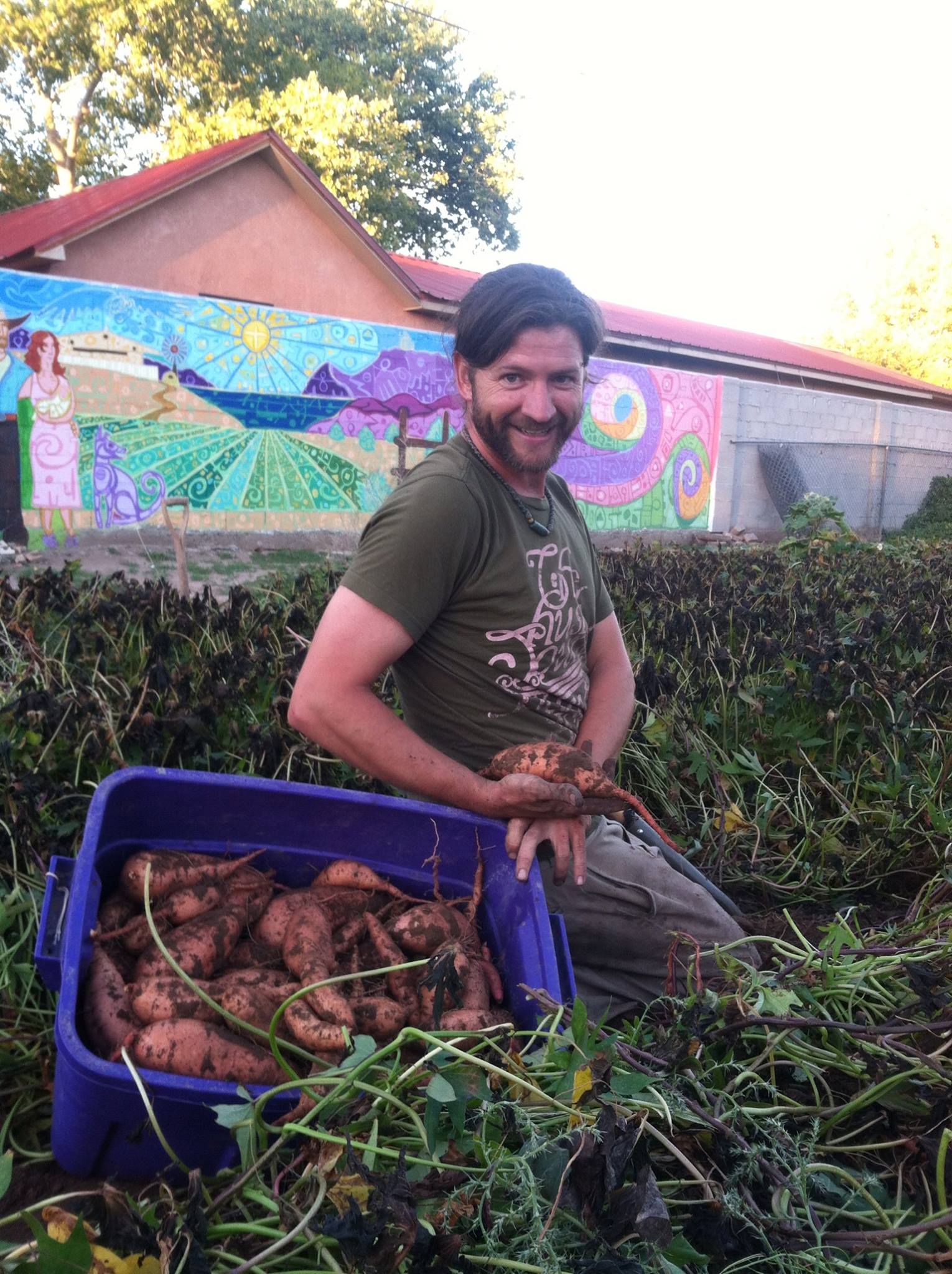
Jack West pictured with a successful sweet potato harvest.
Going back to his title of “Sweet Potato Guy”, he and Willy Carleton, another farmer that worked with Doug Jones in North Carolina, had set off with the goal of growing sweet potatoes in New Mexico. They drove all the way out to North Carolina and carefully transported them back, going as far as taking them into their hotel room every night during the trip. Those efforts proved worthwhile because the slips ended up being perfect for the Middle Rio Grande region. Once they were able to build up their supply of sweet potato slips, they began selling to people.
After that momentum started, Jack got into contact with other farmers who shared their own experiences, like Patricia Allaire of Simple Revolution? Farm! who taught him how to start onions. He ensured other farms had access to grow their own sweet potatoes and he offered to set up nurseries for Chispas Farm, North Valley Organics, and Vida Verde Farm. He brings this thoughtfulness into seemingly every facet of farming, even the not-so-glamorous aspects like burnout. According to Jack,
“Even burnout and failure is kind of a part of any person’s career evolution. It shouldn’t be seen as a failure, unless you can preemptively avoid it.”
He acknowledges that, yes, failure can be a huge challenge or setback, however you can work to reframe some of that outlook. Jack chose to analyze how his productivity changes working with people versus working by himself, how to prepare for a fight instead of hoping one doesn’t come. All of this leads to a better understanding of what comes next.
Lessons Learned
If you can take anything away from this narrative, Jack hopes it would be to:
“Eat the food you grow, eat with people, and when you set your table for dinner, always set an extra place in the hopes that someone will join you.”
He strives to blend laughter, hard work, and simple living—and while those seem like they may oppose each other—Jack has found a way to do it. Hopefully after reading this, you too can find a way to incorporate some of these ideas into your everyday life.